

Search results for 'rco and x y'


-
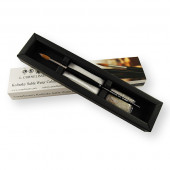
Cornelissen Series 1855 Sable
£61.00Cornelissen Series 1855 Sable Brush Size 12. The box contain 1 x Artists' Quality Kolinsky Sable watercolour Brush and a brush soap. Learn More -
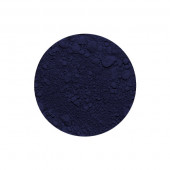
Phthalo Blue Pigment
Starting at: £8.00
PB15:3
Phthalo (Mona) Blue is a synthetic organic pigment, Copper Phthalocyanine, that has been in use since the 1930s. It has an extremely high tinting strength and is a staining colour, so cannot successfully be lifted in watercolour. It requires a wetting agent to fully disperse into a medium, and, when used at full strength, a copper sheen is visible in dried paint film. It is transparent, very lightfast, and has a medium-to-slow drying rate in oil.
Toxicity: C
While stocks last
Learn More -
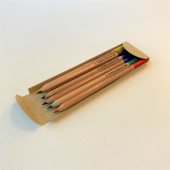
Cornelissen Miniature Coloured Pencil Set
£5.00This pencil set comprising of the highest quality strongly pigmented coloured pencils is a perfect companion when sketching on the go. Pair it with one of our enamel watercolour sets and watercolour postcard books for a compact art set for plein air painting.
Learn More -
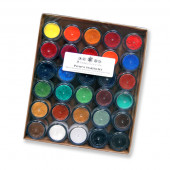
Pigment Set of 30 Colours
£119.00The perfect introduction to working with pigment, this selection of thirty pigments provides a wide range of colours for the production of paint. Each colour is supplied in a 15ml plastic jar, and the set includes both natural and synthetic colours. Recipes can be found on our homepage, with instructions for making different paints, including watercolour, egg tempera and oil paint. Learn More
-
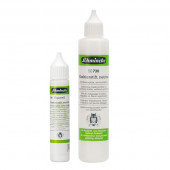
Schmincke Masking Fluid
Starting at: £7.35
Drawing gum for masking specific areas which should remain white on water-colour paper, smooth drawing carton, photographs or films. For direct application with the dispensing bottle. Contains: synthetic resin dispersion without ammonia. Learn More -
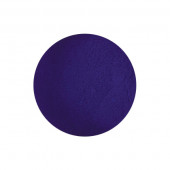
Prussian Blue Pigment
Starting at: £5.20
PB27
Prussian Blue is a synthetic organic pigment that was discovered by the paint maker Diesbach, apparently by accident, in Germany in the early eighteenth century. For many years, it was used not only as a colour in its own right, but also as a component of the original Hooker's Green. The other ingredient, gamboge, is highly fugitive, which is why many watercolours painted with Hooker's green have taken on a bluish tone with with age.
It is a very transparent and heavily staining colour. It dries quite quickly in oil, and can therefore wrinkly if applied too quickly. It is suitable for use in oils, watercolour, and egg tempera. However, it shouldn't be used in conjunction with alkali substances, such as Lead White or Calcium Carbonate as it can turn brown, so it isn't suitable for fresco. For the same reason, it isn't used with acrylic resin binders due to their alkaline nature, so most paint manufacturers will replace Prussian Blue with a mixture of Phthalo Blue and black in their acrylic ranges. It requires a wetting agent to fully disperse into a binder.
Toxicity: B
Learn More -
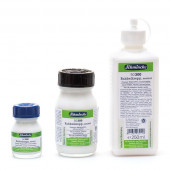
Schmincke Liquid Frisket
Starting at: £4.55
Drawing gum for masking specific areas which should remain white on water-colour paper, smooth drawing carton, photographs or films. Apply with writing pen, cotton bud or wooden stick. Contains: synthetic resin dispersion without ammonia. Learn More -
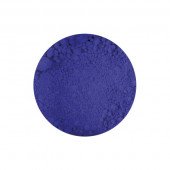
Cobalt Blue Pigment
Starting at: £6.30
PB28
Cobalt Blue is an artificial mineral pigment, produced by the calcination of cobalt oxide and aluminium oxide. It has been widely used since the early 1800s, following its discovery by the French chemist Thenard at the beginning of the century. The name Cobalt has its roots in the German word Kobold, meaning imp or evil spirit. German miners named it to in the late-Middle Ages, as the presence of cobalt ore in the mines made the extraction of silver more difficult. They were possibly also aware of the toxic properties of the mineral that was frustrating their efforts.
Cobalt remains a very popular colour today, and is present in most ranges of paints, being a semi-transparent pigment that is stable in all media. As a watercolour, all cobalt pigments tend to granulate. As an oil paint, it requires less oil content than most other pigments, and dries quite quickly. Like Cerulean Blue, some artists may choose to bind it with poppy oil, to avoid any possible colour changes brought about by the yellowish cast of linseed oil and the pigment's weak tinting strength.
Limeproof
Toxicity: C
Learn More -
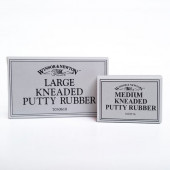
Winsor & Newton Kneadable Erasers
Starting at: £2.50
-
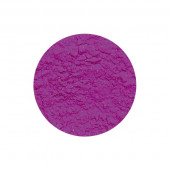
Cobalt Violet Light Pigment
Starting at: £10.00
Cobalt Violet Light Pigment (PV14). Synthetic inorganic pigment. Semi-opaque. Weak tinting strength. Excellent Lightfastness. Fast drying rate. Good for oil and watercolour but not acrylic as pigment 'settles out'. Used since early 1900's. This colour cannot be matched through mixing other colours.
Limeproof
Toxicity: C
Learn More -
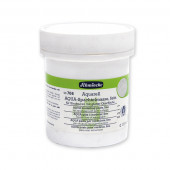
Schmincke AQUA Modeling Paste Medium
Starting at: £9.60
-
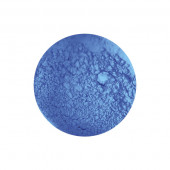
Manganese Blue Pigment
Starting at: £49.50
PB33
Manganese Blue is an articficial mineral pigment, that is prepared by heating sodium sulphate, potassium permanganate and barium nitrate to 750-800 degrees Celcius. It has been produed as a pigment and as a colourant for cement since the 1930s, and is notable for its quick drying time in oils, its high transparency, and its bright, slightly greenish colour. Its weak tinting strength can cause it to be overwhelmed in mixtures, and it has a tendency to granulate as a watercolour. It is no longer used in commercial paints, but many manufacturers offer a Manganese Blue Hue, which is typically based upon Phthalocyanine Blue.
Production of this pigment has now ceased, due to environmental and health concerns, therefore it is only available while stocks last.
Toxicity: C
Learn More -
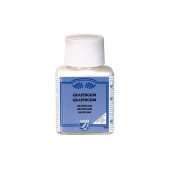
Lefranc Graphigum Masking Fluid 75 ml
£4.90Lefranc Graphigum is a latex-based liquid frisket used for masking areas of a watercolor painting with a brush to protect them from the application of colour. It can be rubbed off with your fingers and leaves no mark on the support. Size: 75 ml Learn More -
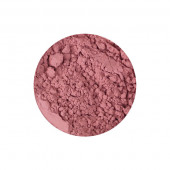
Potters Pink Pigment
Starting at: £7.30
PR233
Potter's Pink is an artificial mineral pigment produced by roasting tin oxide with various other oxides. It was first discovered in the pottery region of Staffordshire in the late-1700s, and in the following century Winsor & Newton introduced Potter's Pink into their watercolour range under the name "pink colour". It went on to become a popular addition to watercolour palettes, offering an opaque, lightfast colour with a weak tinting strength and a medium level of oil absorption.
Toxicity A
Learn More -
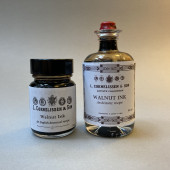
Cornelissen Historical Inks, Walnut
Starting at: £9.00
Made from organic walnut husks collected in Cambridgeshire, this deep brown walnut ink is made to an 18th-century formula. Small batches of the ink are blended to give the required consistency and strength. It has good permanence, but will eventually fade if left in direct sunlight for sustained periods of time, and is not wholly waterproof, but has some staying power, especially on sized watercolour papers. As with all handmade products derived from natural ingredients, there may be slight variations in the colour and consistency as a result of seasonal changes.
Learn More -
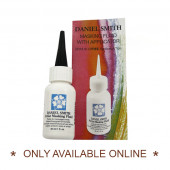
Daniel Smith Art Masking Fluid 30ml
£8.50Daniel Smith Masking Fluid offers excellent coverage and easy-flowing application. If left on a painting for a week, a month, or more, it can still be removed cleanly from all watercolour surfaces with an eraser. Included are five fine-point tips that can be attached to the bottle and used as a drawing tool to make dots, fine lines, and to save details and highlights. Brush it on, or apply straight from the bottle. Off-white when wet, it dries to a transparent caramel colour. *Please note, this product is stored offsite. Please allow extra time for your order to be processed and dispatched. Learn More -
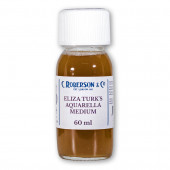
Roberson Turcks Aquarella
Starting at: £18.50
For watercolour painting on paper, ivorine, terracotta, wood and fabric. Sizing not needed. Prevents the running of colours, even on open weave fabrics. Learn More -

ArtGraf Blue Tailor shape
£5.80Inspired by traditional tailor’s chalk block, prepared for drawing and painting. Water soluble and extremely soft. Learn More -
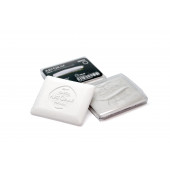
ArtGraf White Tailor shape
£5.80Inspired by traditional tailor’s chalk block, prepared for drawing and painting. Water soluble and extremely soft. Learn More -

Gum Arabic
Starting at: £4.25
Gum Arabic is a resoluble binding agent, commonly used in the preparation of watercolours, but also useful as an adhesive, a size, and in the production of soft pastels. It is a natural product, harvested from the Acacia tree between October and May. The highest grade of Gum Arabic comes from the Kordofan region of Sudan. It is exceptionally pale and pure and therefore particularly suited to watercolour painting, while Nigerian Gum Arabic (while stocks last) is better suited to stone lithography and other printmaking techniques. Please see the Formulas & Recipes section on our homepage for a recipe to make your own watercolour paints using Gum Arabic (currently under construction). Learn More -
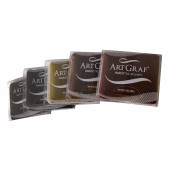
ArtGraf Traditional Tailor Shape Colours
Starting at: £5.80
Inspired by traditional tailor’s chalk block, prepared for drawing and painting. Water soluble and extremely soft, choice of 6 traditional earth colours: sanguine, sepia, dark brown, brown, ochre and carbon black. Learn More -
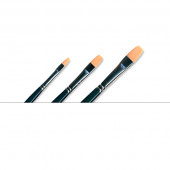
da Vinci Series 122 Cosmotop One Stroke
Starting at: £3.50
Finest golden synthetic fibre. More springy than Cosmotop Spin making it an excellent brush for watercolour, gouache, acrylic and oil painting. Learn More -
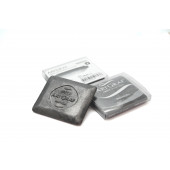
ArtGraf Graphite Tailor shape
£5.80Inspired by traditional tailor’s chalk block, prepared for drawing and painting. Water soluble and extremely soft. Learn More -

ArtGraf Red Tailor shape
£5.80Inspired by traditional tailor’s chalk block, prepared for drawing and painting. Water soluble and extremely soft. Learn More -

Gum Copal Manila
Starting at: £6.00
Gum Copal Manila is derived from the resin of a coniferous tree native to the Philippines. It is not to be confused with other copals, which are the product of fossilised plant materials. It can be dissolved in alcohol to make a spirit varnish, to be used as a substitute for shellac, or as a fixative for pastel and charcoal drawings. Please note, that when used as a fixative it may darken the colour of the image. Learn More -

ArtGraf Carbon Black Tailor shape
£5.80Inspired by traditional tailor’s chalk block, prepared for drawing and painting. Water soluble and extremely soft. Learn More -
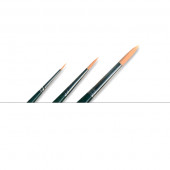
da Vinci Series 5570 Cosmotop Nova Round
Starting at: £3.35
Finest golden synthetic fibre. More springy than Cosmotop Spin making it an excellent brush for watercolour, gouache, acrylic and oil painting. Learn More -

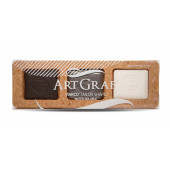
ArtGraf Tailor Shape Set of 6
£36.00Inspired by traditional tailor’s chalk block, prepared for drawing and painting. Water soluble and extremely soft, the set contains 6 traditional earth colours: sanguine, sepia, dark brown, brown, ochre and carbon black Learn More -
-
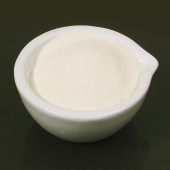
Casein Lactic
Starting at: £18.30
Casein is a protein derived from dried milk, which has been used in painting since ancient times. It can be combined with Ammonium Carbonate to form an emulsion, which acts as a durable, non-resoluble binder for pigments, producing a matte, fast-drying paint, similar in appearance to egg tempera. We use casein as a binder for our L. Cornelissen & Son Pigment Colour Charts, as it is a medium that clearly showcases the characteristics and behaviour of each pigment in its pure form. Casein paints can be applied in thin layers to watercolour paper, but would require a more rigid support, such as a gesso panel, to be applied thickly, as the comparative inflexibility of the paint layer means that it can be prone to cracking. Subsequent layers of paint should be more diluted to aid adhesion, and impasto effects are not recommended. It is possible to varnish casein paintings using an acrylic or damar varnish to obtain a glossy surface if desired, although this is not a necessary step. Casein can also be used as an ingredient in gesso, and is a suitable binder for fresco secco techniques.
Some pigments may require a wetting agent in order to fully disperse within the binder, in which case alcohol may be used.
Learn More
Shopping Options
- Category
-
- Pigments, Gums & Resins (12)
- Oils & Acrylics (7)
- Watercolour (43)
- Pastels (4)
- Drawing / Calligraphy (22)
- Gilding & Restoration (13)
- Printmaking (1)
- Brushes (11)
- Paper (8)
- Studio (15)
- Manufacturer
-
- Arches Aquarelle (1)
- ArtGraf (13)
- Bockingford (2)
- Cornelissen (35)
- Da Vinci (5)
- Daler-Rowney (2)
- Daniel Smith (11)
- Faber-Castell (2)
- Fabriano (2)
- Golden (1)
- Khadi (1)
- Lascaux (1)
- Lefranc et Bourgeois (2)
- Maimeri (1)
- Pro Arte (1)
- Roberson (4)
- Schmincke (16)
- Stabilo (2)
- Winsor&Newton (6)
- Sennelier (3)
You have no items in your shopping basket.

- Search Brands
-