

Your search 'Boards for egg tempera' did not match any products.
Showing results using some of your search terms 'Boards for egg tempera'
Search results for 'for egg tempera'
10 Item(s)
Grid List

-
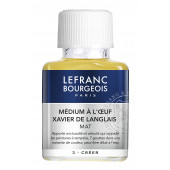
Lefranc Xavier Egg Medium
Starting at: £9.10
Lefranc Bourgeois are a paint manufacturer with a long history of supplying to artists since their beginnings in 1720.
From their website: The Xavier de Langlais egg medium makes paints more creamy, accelerates their drying time and enables painters to create layers of velvety oil paint with a matt or glossy finish according to the amount used. It creates a matt (8 to 10 drops) or glossy (4 to 5 drops) look. This highly original recipe from Xavier de Langlais comes from early Italian painters who used an egg-based emulsion to set and hold the colour. The wet-look technique is called “tempera” and is perfectly balanced and stable to create perfect brush strokes. We recommend shaking it well before use so that the paint is nice and creamy.
Learn More -

Techniques of Icon and Wall Painting
£40.00Techniques of Icon and Wall Painting - Egg Tempera, Fresco, Secco by Aidan Hart. The most comprehensive description to date of the techniques, formulae and history of Icon and Wall Painting. The book is beautifully designed and over its 490 pages, there are 450 coloured images and 180 drawings. Cornelissen materials are included in the text and in the images. Learn More -
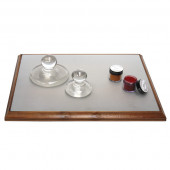
Mixing Slab
Starting at: £19.95
A glass slab with wooden cradle for the grinding of pigments.
The friction created between the sand-blasted surfaces of the glass slab and muller facilitates the thorough mixing of pigment and medium, creating a consistent and strong paint body. This slab can be used to manufacture many types of paint including watercolours, egg tempera and oils.
Mulling is of particular importance when making oil paint; simply mixing pigment and oil together using a palette knife will result in an unstable substance with poor plasticity, which contains a large amount of excess oil and unevenly distributed pigment particles. Thorough mulling in a figure-of-eight motion will enable the pigment to be fully combined into the binder, strengthening the resultant paint film.
PLEASE NOTE: This item is in stock but it is a call to order item due to the fact that we cannot guarantee its safe delivery, however well we package it. Please ring us to discuss your delivery options.
Learn More -
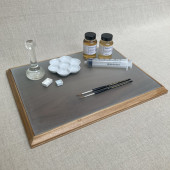
Watercolour paint making set
Starting at: £0.40
A collection of equipment and ingredients useful for making watercolour by hand. This selection of quality materials has been put together for the begginer and intermediate paint maker alike. This set includes:
Equipment to mix the paint and fill watercolour pans:
Glass slab with hardwood stand
Cornelissen small muller
Small (half pan) and large (full pan) watercolour pan
Ingredients to make the watercolour binder :
Roberson Gum Arabic
Roberson Ox Gall
Equipment for painting:
Cornelissen 80a sables brushes in sizes 3 & 6
cermaic palette in flower shape
Learn More -
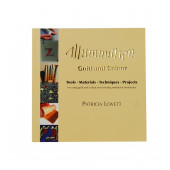
Illumination Gold and Colour Book
£15.00Patricia Lovett is one of the world’s leading authorities on the techniques and practical processes of making mediæval manuscripts. She lectures and teaches all over the world on calligraphy and illumination, and has written about a dozen books on these subjects, as well as producing a DVD – Illumination – Tools, Materials, Techniques, Projects. Patricia has run calligraphy courses as well as those on traditional manuscript gilding and painting techniques, and was awarded an MBE for her services to heritage crafts and calligraphy. This book takes the beginner and those with more experience through step-by-step processes to produce simple and easy projects using cheap metals and modern adhesives, and also to create mediæval miniatures and illuminated scrolls on vellum (animal skin). Learn More -
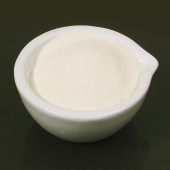
Casein Lactic
Starting at: £18.30
Casein is a protein derived from dried milk, which has been used in painting since ancient times. It can be combined with Ammonium Carbonate to form an emulsion, which acts as a durable, non-resoluble binder for pigments, producing a matte, fast-drying paint, similar in appearance to egg tempera. We use casein as a binder for our L. Cornelissen & Son Pigment Colour Charts, as it is a medium that clearly showcases the characteristics and behaviour of each pigment in its pure form. Casein paints can be applied in thin layers to watercolour paper, but would require a more rigid support, such as a gesso panel, to be applied thickly, as the comparative inflexibility of the paint layer means that it can be prone to cracking. Subsequent layers of paint should be more diluted to aid adhesion, and impasto effects are not recommended. It is possible to varnish casein paintings using an acrylic or damar varnish to obtain a glossy surface if desired, although this is not a necessary step. Casein can also be used as an ingredient in gesso, and is a suitable binder for fresco secco techniques.
Some pigments may require a wetting agent in order to fully disperse within the binder, in which case alcohol may be used.
Learn More -
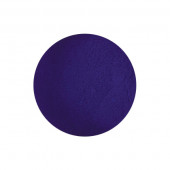
Prussian Blue Pigment
Starting at: £5.20
PB27
Prussian Blue is a synthetic organic pigment that was discovered by the paint maker Diesbach, apparently by accident, in Germany in the early eighteenth century. For many years, it was used not only as a colour in its own right, but also as a component of the original Hooker's Green. The other ingredient, gamboge, is highly fugitive, which is why many watercolours painted with Hooker's green have taken on a bluish tone with with age.
It is a very transparent and heavily staining colour. It dries quite quickly in oil, and can therefore wrinkly if applied too quickly. It is suitable for use in oils, watercolour, and egg tempera. However, it shouldn't be used in conjunction with alkali substances, such as Lead White or Calcium Carbonate as it can turn brown, so it isn't suitable for fresco. For the same reason, it isn't used with acrylic resin binders due to their alkaline nature, so most paint manufacturers will replace Prussian Blue with a mixture of Phthalo Blue and black in their acrylic ranges. It requires a wetting agent to fully disperse into a binder.
Toxicity: B
Learn More -
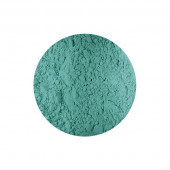
Verdigris Pigment
Starting at: £4.90
Verdigris is an artificial pigment that dates from antiquity. Originally, it was produced by exposing copper to vinegar; nowadays acetic acid is used. It is acidic, so can contribute to the deterioration of paper supports. For this reason, it is more suited to oil or tempera painting than it is to watercolour. In tempera painting, it should be bound in animal glue or isinglass glue rather than egg york. When used in oil painting it should be held in a resin oil or balsam such as Venice Turpentine, as it can turn brown when ground directly into linseed oil. It is a fast-drying, transparent pigment, with a visible crystalline structure.
Larger quantities are available by request.
Learn More -

Gum Sandarac
Starting at: £8.60
Gum Sandarac, derived from a coniferous tree, is available in powdered or lump form. It can be dissolved in alcohol to create a varnish that is suitable as an isolating layer in oil painting and as a traditional top coat for egg tempera. It forms a brittle layer, so is only suitable for use on a rigid support. Another application is as a surface preparation for calligraphy; the ground gum can be dusted across a piece of prepared vellum or paper to create a resist, which shrinks ink strokes slightly, making them appear finer, with crisp edges. Learn More -
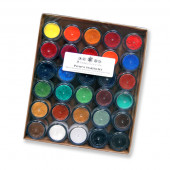
Pigment Set of 30 Colours
£119.00The perfect introduction to working with pigment, this selection of thirty pigments provides a wide range of colours for the production of paint. Each colour is supplied in a 15ml plastic jar, and the set includes both natural and synthetic colours. Recipes can be found on our homepage, with instructions for making different paints, including watercolour, egg tempera and oil paint. Learn More
10 Item(s)
Grid List
Shopping Options
- Category
-
- Pigments, Gums & Resins (6)
- Oils & Acrylics (1)
- Watercolour (1)
- Drawing / Calligraphy (1)
- Gilding & Restoration (1)
- Studio (3)
- Manufacturer
-
- Cornelissen (8)
- Lefranc et Bourgeois (1)
- Roberson (1)
You have no items in your shopping basket.

- Search Brands
-